The Cinémathèque française just opened an amazing Jacques Tati exhibition (8 April - 2 August 2009) that really makes me wish I were in Paris and not here. I've noticed that in conjunction with this event, several books on Tati are to be published in April and May, but the definitive one seems to be the exhibition catalogue published by Naïve:
Before they were an independent publisher, Naïve were (and still are) an indie record label, and back in February they issued Sonorama !, a double-CD set of all of the music featured in Tati's films (which is amazing, by the way). Of course, there have been at least two other collections of Tati's film music issued on CD but, to use that word again, this really does appear to be the definitive collection.
Now if only their Canadian record distributor hadn't gone bankrupt last year, and if only their Canadian book distributor weren't so incompetent, then we'd be all set...
See also: controversy surrounding Tati's pipe and anti-tobacco legistlation.
After a year-and-a-half's absence, the Berlin-based, Franco-German duo Stereo Total, a.k.a. The Best Pop Group in the World, will be returning to Montreal. The details are as follows:
Zoo-Prod présente STEREO TOTAL with Leslie & The Ly’s + Donzelle LE NATIONAL - 1220 Ste-Catherine Est Vendredi le 20 mars 09,21h*Portes20h* Infos 514.845.2014 Admission générale
From Françoise and Bretzel :
Put the Martini into the shaker and the burger on the grill! We're going back to USA & Canada. [...] We are coming on tour next spring (March-April) and are just recording a tour-single called "Anti Love Song", in which all numbers are sung in really bad English, but they are negatively lovely.
I've been a huge fan of this band since I first stumbled upon Musique Automatique in the new releases at Music Trader back in 2002, attracted as I was by all the French and German (my two favourite foreign languages!) sillyness on the front and back of the packaging. It's quite thrilling all these years later to be livingin a city where I can actually see them in concert; with the closure of Le Parisien cinemas, and the impending reconversion of Ex-Centris, at least there are still some upsides to living in Montreal.
On the first page of the first chapter of his 2001 book The Flâneur, Edmund White describes La Défense as having gone ‘directly from being futuristic to being passé without ever seeming like a normal feature of the present’. He then goes on to say:
Honestly, instead of ‘like a normal feature of the present’ I almost wrote 'without ever being inscribed within the interior of the present'. That's how much I've been submerged in contemporary French nonfiction. I frequently have to stop and ask myself how a human being might put the same idea.
Obviously this is a bit of exaggeration for the sake of a bon mot, but as someone who does a fair bit of translation from French to English, and proofreading of texts translated from the French, I have to say that I find this absolutely hilarious. I am forever asking myself the very same question: just how would a human put that? Hmm...
Before seeing Burn After Reading a few months ago, I don't think I had ever seen Brad Pitt in a film. I made no distinction between him and any number of other unintersting 'stars' in the banal Hollywood system. This Japanese advert is the second thing I've seen him in and, lo and behold, it doesn't suck either. It's an hommage to Jacques Tati's Les vacances de Monsieur Hulot (with Pitt as an ersatz Monsieur Hulot), featuring a Serge Gainsbourg soundtrack. The spot was directed by Wes Anderson for the Japanese telecommunications company SoftBank, and was filmed in Normandy (Trouville?) in September 2008.
It's anachronistic (the original film is from 1953, and the music is from 1965) and obviously never going to be as good as the original, but at the same time when you combine 'Japanese advert', 'Serge Gainsbourg' and 'Jacques Tati', the result is always going to be worth a look, and this is certainly far more entertaining that anything we ever see in North America. Ici, on nous prend pour des cons !
I've been so out of touch with the scene lately that I didn't even realise that the sublime intro music to Louise Bourgoin's weather report on Canal+ is actually a Canadian indie song. La preuve en images:
This impossibly lush song is in fact Melody Day by Vancouver's Caribou. Before this Dick threatened him with legal action, Caribou used to be called Manitoba, which is where I come from, and last night he played Montreal, which is where I live. Et voilà, la boucle est bouclée.
A hundred years after it was written, Robert Walser's »Der Gehülfe« (The Assistant) is finally available in English. Susan Bernofsky's translation was first published by New Directions in July 2007, but I held off because I already had a copy of Bernard Lortholary's masterly French translation first published in 1985. But then this month Penguin UK had to go and release a gorgeous edition of Bernofsky's translation in the newly redesigned Penguin Modern Classics series, and so I was forced to import the book from the UK, at great personal expense I might add. Les salauds!
Here's an amusing passage, pertaining to the prestige enjoyed by the French language in foreign lands:
"Une jolie petite française", the conductor's wife said, evidently overjoyed at having an occasion to recite a few French words she knew by heart. This is always the case in Germanic lands, people love to be able to show that they understand French.
"Frau Tobler," Joseph thought, "knows no French at all, the poor thing!"
Robert Walser, »Der Gehülfe« (The Assistant), 1907, translation Susan Bernofsky (2007)
« Une jolie petite française », dit en français la femme du contrôleur, manifestement ravie d'avoir l'occasion de débiter de mémoire quelques mots en français. C'est toujours ainsi dans les pays de langue allemande : les gens sont contents de pouvoir montrer qu'ils comprennent le français.
« Ma patronne, pensa Joseph, ne comprend pas un mot de français. La pauvre! »
Robert Walser, »Der Gehülfe« (Le commis), 1907, traduction Bernard Lortholary (1985)
It's times like this that you wish Canada were just a bit smaller, to facilitate travel, and that it had a Côte d'Azur, so you would have somewhere to go. I suppose I've always implicitly had this feeling, somewhere in the back of my mind, but when L'Express publishes a feature on the Riviera, including its top 10 beaches, effectively rubbing it in your face, there's really no escaping it, is there? You just want to hop into your car and zip down to Juan-les-Pins on the Nationale 7, that mythical link between the capital and the sea & sun that Charles Trenet celebrated in song back in 1955. Have a listen to Stereo Total's 2001 cover version of his Route Nationale 7 by clicking here (the location of this mp3 sample is dynamic, so I couldn't embed it in the page, but this m3u file that points to it appears to be static; the link will launch your computer's default application for m3u files). Despite the advent of motorways and TGVs, the queen of the routes nationales is still the way to travel.
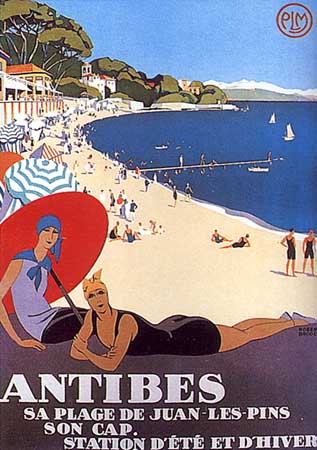
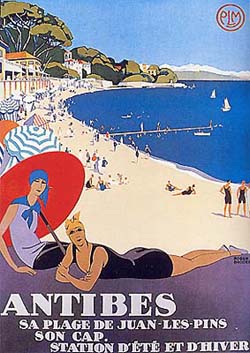
Unfortunately for me, an excursion to the Riviera is just out of my reach, so I'll have to settle for Jim Ring's new(ish) book Riviera: The Rise and Rise of the Côte d'Azur, and my old 1:100000 scaleMichelin map of the Côte d'Azur from 1989. Also, in keeping with the theme, I highly recommend J.G. Ballard's 2000 literary techno-thriller Super-Cannes, as well as his review in The Guardian of the aforementioned book by Jim Ring. Finally, if you like these two vintage posters, you'll want to know that both were designed circa 1930 by a certain Roger Broders, the most accomplished affichiste of the golden era of French travel posters. He seemed to mainly do work for locations on the French Riviera and in the French Alps (including this alpine masterpiece from 1927 that I have hanging up on my wall), but he also realised posters for locations around the world. If you're as hardcore as me, you'll also want to pick up the recueil of his travel posters recently published by Queen Art.
Le grand public pense que les livres, comme les oeufs, gagnent à être consommés frais. C'est pour cette raison qu'il choisit toujours la nouveauté. -Goethe (via Heileen)
Goethe is saying that the general public thinks that books, like eggs, should be consumed fresh. For this reason, the average punter tends to choose new releases. Of course the average punter these days isn't likely to choose a book at all, but this idea can be applied to the consumption of culture in general (television, cinema, etc.).
This is as true today as it was in the time of Goethe, particularly in the Anglo-saxon publishing world, where new releases in hardback can be found piled high in supermarket bargain bins just months after publication, thereby making room in the 'proper' bookshops for the next slate of throwaway bestsellers.
In the world of French publishing, hardbacks barely even exist anymore. Most new releases are done in a high-quality trade paperback format, and very often they remain in print for decades after their initial publication. After a year or so many books will also be available in the poche format, which is of a slighly better quality than the Anglo-saxon mass market paperback format. I wouldn't be surprised if the hardback format remains in use in the Anglo-saxon publishing world specifically because it stands up better to the demands of the supermarket bargain bin environment, i.e. an environment where books are chucked about by philistines like so many pieces of worthless tat.
What can you say? You just get the feeling that the written word is treated with more reverence in certain cultures than in others. Different strokes for different folks...
The newest feature of this blog is the tried and tested Quote of the Day. This, the inaugural entry, comes courtesy of Lucas Armati writing in Télérama's Blog Télévision:
Marre de ces [....] documentaires dont le seul suspense consiste à savoir s'il s'agit d'une coproduction franco-allemande ou germano-française ?
Lamenting the state of summertime telly in France, he asks: 'Aren't you sick of these documentaries whose only suspense consists of finding out if it's a Franco-German or Germano-French co-production?'
The bridge is both chaotically modern, and graceful, preserving a long tradition of epoch-defining but beautiful Parisian bridges going back for 400 years.
[....]
Paris has more river bridges than any other city.Other river-bisected cities, such as London, Rome and Budapest, have a dominant bank. The Right Bank and Left Bank of Paris, although different in character and preoccupations, are equal partners.
The President lives on the Right Bank; the Prime Minister's official residence is on the Left Bank. The principal business quarter is on the right, but the parliament and most academic institutions are on the left. Ministries and museums are scattered on both sides. Some urban historians say that the proliferation of bridges explains why Paris has developed so evenly on both sides of the river. Others suggest that the fact that both Rive Gauche and Rive Droite were equally important forced the Parisians to build a lot of bridges.
[....]
The oldest surviving Paris bridge is, theoretically, Le Pont Neuf (the new bridge), completed in 1607. Its 12 low, sweeping arches and its breadth made it one of the wonders of Europe in the 17th century.
[....]
The Simone Beauvoir bridge continues this all-purpose tradition. If you walk along the oak planks all the way from the high sides of the Parc de Bercy to the top of the steep steps in front of the library, you cover 300 metres. You can, however, divert on to the lower deck or arrive or leave by the slopes, stairs and lifts to the lower Seine quays.
The high deck gives you a splendid view of eastern Paris, with the double-deck Bercy bridge carrying both Metro trains and cars in the foreground. There are glimpses from the northern end of the Eiffel Tower and Notre Dame. The lower deck takes you close to the water, just above the tourist launches and the barges full of coal or gravel.
It could be my small-town naïveté, but I have never heard of anything like this. Paris has just inaugurated (slideshow) its 35th municipal public baths. Nothing too extraordinary in that, except that this swimming pool floats on the Seine. It's called the Piscine Joséphine Baker and is moored on the Left Bank, just opposite the Bibliothèque Françcois-Mitterrand. On board this floating marvel, in addition to a 10x25 metre swimming pool, one can also enjoy a pataugeoire, saunas, a jacuzzi, Turkish baths, a restaurant and snack bar and a fitness centre including weight room. There are also two solariums, one on board and one on the adjacent land, where people can relax and get a natural tan. If that weren't enough, it also has an eco-friendly ozone water treatment system that purifies the water from the Seine as it is pumped into and out of the pool. The facility will be operate daily, year round (the roof can be opened or closed in a matter of minutes), and will be open as late as midnight on certain days.
The construction took 18 months and cost 17 million euros. Bertrand Delanoë, the Socialist mayor of Paris, says that the most important thing about this realisation is that it enables all citizens to have access to what is beau and joli. I cannot imagine a publicly-funded project in this part of the world going ahead on that basis. The concept that beauty could somehow improve or enhance our lives and therefore be considered to be a legitimate aim of the state (i.e. if you're already going to build a swimming pool, you might as well put in a bit of effort and make it interesting and not ugly) is completely and utterly foreign in these parts.
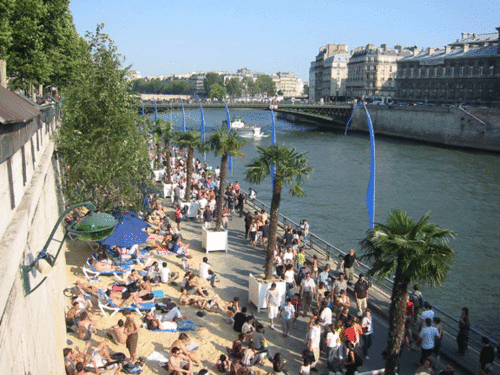
The Piscine Joséphine Baker is right next to the brand new Passerelle Simone de Beauvoir, an ultra-modern footbridge over the Seine that's due to open tomorrow. It's the 37th parisian bridge currently spanning the Seine and, according to The Independent, Paris continues to boast more river bridges than any other city in the world. Together, the floating pool and footbridge will form the centrepiece of this year's Paris Plages, which since 2002, through the reduction of traffic, the importation of huge quantities of sand and the organisation of numerous activites, has transformed the Right Bank(and as of this year also the Left Bank) of the Seine into a beach-front holiday resort for those not fortunate enough to escape the capital during the summer holiday season. Of course one can access Paris Plages by métro, bus or boat, and there's even a boat service linking the different sites. It all sounds like too much fun. As the self-proclaimed River City of Canada, we should try something similar over here. It will never happen though. The mayor's too busy covering our urban parkland with condos.
As an aside, both Le Montieur and French Duck report that there used to be another floating swimming pool on the Seine called the Piscine Deligny. The details are a bit sketchy, but it was apparently run as private enterprise and was bulit back in 1805. Depending upon who you believe, it sunk either on 8 July 1993, or sometime in 1995. Meanwhile, Delanoë has promised a second floating municipal pool, to be moored in the 15th arrondissement, just oppositeAndré Citroën Park. It should be ready by 2010 at the latest.
I tell ya, it's a heck of a town. Can you imagine what sort of things they would be coming up with if they had actually been awarded the 2012 Olympics? The mind boggles...
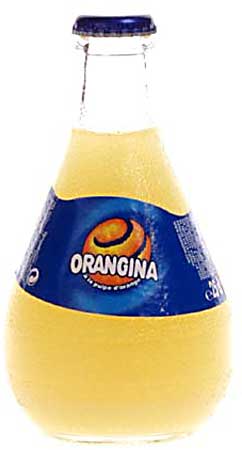
Hooray! I've finally found someone in Winnipeg that sells Orangina in a nice, big 1750mL bottle. Much better than paying $2 for a tiny little bottle on Osborne, Corydon or Provencher. You know Orangina, right? That wonderful little French drink that's not much more than carbonated water and orange juice, the Orangensaft mit Sodawasser that I so enjoyed during my boyhood trip to Europe. But it's not just that it tastes better and is more refreshing than any soft drink you've ever had. There's also the legendary iconography created by Bernard Villemot, of which the poster featured here is the best known example. I must confess that the whole Orangina experience somehow transports me to the Côte d'Azur, perhaps during the earlier part of the twentieth century, and I can just imagine myself relaxing at Antibes or Juan-les-Pins, enjoying the sun and sipping a surprisingly refreshing citrus-based carbonated beverage. Ridiculous, certes, but much more enjoyable than living in the real world. If any of this resonates with you, then you will certainly want to visit the Virtual Orangina Museum, and to see more of the work of Bernard Villemot. If you're really hardcore like me, then you will also want to pick up the beautiful book (see below for purchasing information) that came out last year featuring Villemot's best posters (Hoëbeke, 2005).
European poster art, especially the art of the French advertising poster of decades gone by, has always fascinated me. In the future there will be more posts related to this most agreeable of topics.
To buy the book, choose the option nearest you: [Canada] [France]
I love French culture. I love French music. I especially love French sixties music. Vidéo Nostalgie serves up classic music videos from this era that I am too young to have seen at the time and too far away from France to be able to see today on Télé Mélody.
Written by Serge Gainsbourg, one of the greatest pop geniuses ever, and perfromed by France Gall, it won the 1965 Eurovision Song Competition. Isn't it wonderful? It must surely be one of the best pure pop songs of all time and has always been a favourite of mine. Vidéo Nostalgie is simply chock-full of gems like this. Highly recommended!
Il s'agit d'un des moments de télé les plus rigolos que j'ai jamais vu. Je crois que ça date de Cannes 2003, lorsque le plateau de On a tout essayé s'est déplacé pour une semaine sur la Croisette. Nous, les malheureux qui habitent les lointaines provinces anglophones de l'ouest du Canada, avons pu suivre tout cela grâce à TV5. J'en ai toujours gardé le souvenir et je suis ravi d'avoir retrouvé le clip. Il s'agit de Hugues Delatte (journaliste inepte et l'alter-ego de Raphaël Mezrahi) qui rencontre Britney Spears pour mener son «premier interview professionnel». À découvrir ou à revoir !
I've been listening to On va s'gêner (heard weekdays on Europe 1) quite a bit these days, especially now that it's available as a podcast. When you listen to this daily ninety minute programme, you always seem to hear two or three amusing adverts for the telephone number 118 218, which is a Directory Assistance service in France; an equivalent of our North American 411 if you will. Hearing that advert reminded me of the 118 fiasco that I had heard them talk about on BBC Radio 4 back in 2003 without really knowing what they were talking about.
What could possibly be interesting about Directory Assistance (or Directory Enquiries as the service is known in the UK) you ask? Well, for a normal person, probably nothing. But since I'm not normal I'm going to tell you all about it. Here in North America we dial 411 to find a telephone number. In France you would dial 12 for France Télécom's Renseignements Téléphoniques, and in the United Kingdom you would dial 192 for British Telecom Directory Enquiries. Simple.But these services, and others elsewhere in Europe were monopolies of the (former or current) state-owned telecom providers, so along came a big, bad European Directive which apparently imposed the deregulation and liberalisation of the Directory Enquiries system across the European Union, and also required that 118 be used as the standard prefix for all such services. Lotteries were held in different European countries to allocate these 118 numbers (theoretically 1000 numbers per country are possible: 118 000 to 118 999). This was first implemented in the United Kingdom in late 2003, and apprently caused all sorts of problems, most notably higher costs and worse service for consumers. Even before the changeover and ensuing fiasco, the mourning for the old 192 service had begun. By mid-2004, there were over 120 different UK 118 numbers people could call for directory enquiries, including 118 118, whose adverts I find hilarious, malgré moi. This chappie, however, did not find them quite as hilarious, so the adverts were pulled and the concept has been reinvented as a 1970s cop show parody.
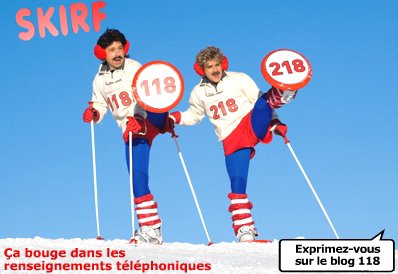
Currently, the deregulation is being implemented in France. 118 numbers are being launched and the old 12 serivice will be discontinuedby spring. This is of course where my radio adverts for 118 218 come in. They have this sort of disco music in the background, and this bloke called 118 is talking to this other bloke called 218, and it's so ridiculous that I can't help but find the whole thing hilarious. Now I see they've got a website, equally hilarious telly adverts, a blog, and a real-life national TouTouYou-Tour (the chorus of the disco jingle is not so much a lyric as a sound that would be written out phonectically as 'toutouyoutou').
Both the Bristish and the French adverts seem equally ridiculous and very similar in nature (vaguely 1970s-looking dodgy chappies with moustaches and silly sports gear doing silly things). At first I thought plagiat!, but it turns out that The Number, which runs 118 118 in the UK, and Le Numéro, which runs 118 218 in France, are the same company. It's interesting that they would use virtually the same adverts in both countries, but it seems to work. Currently, Le Numéro is taking France Télécom to court, accusing them of unfairly withholding information from their directory database and favouring their own directory enquiries service.
I find the whole whole affair, i.e. the reckless deregulation, the lotteries, the fiasco and the ridiculous adverts (not forgetting the offended distance runner) hopelessly amusing.